

BCG Matrix for Value-Driven Consulting
The BCG matrix still works when leaders use it as a disciplined portfolio lens rather than a strategy poster.
1. What It Is
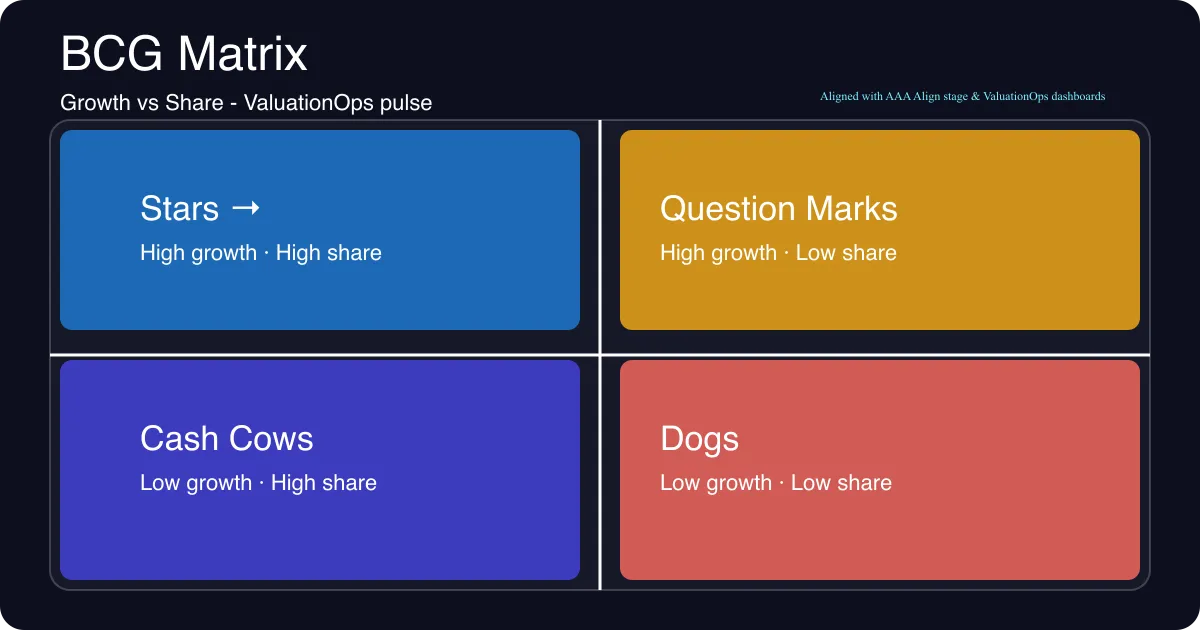
The BCG matrix places offers, business units, or initiatives into four quadrants based on growth and share. On its own, it is a simplification. Inside GFE work, it becomes useful when paired with operational evidence, financial assumptions, and explicit leadership choices.
2. Why GFE still uses it
We do not use the BCG matrix as a stand-alone forecasting engine. We use it as a portfolio decision aid inside Align work.
It helps leadership answer questions like:
- which bets deserve more attention right now
- which offerings should fund the next move
- where process redesign is needed before more spend is committed
- which initiatives are consuming management attention without improving enterprise value
3. GFE interpretation
In our services work, the matrix is stronger when it is connected to:
- process reality from Audit
- KPI and margin context from ValuationOps
- proof-bearing operating evidence rather than intuition alone
That does not mean the Website is the canonical owner of ValueLog or trust semantics. Where evidence semantics matter, the constitutional source remains Skill Spec:
4. Framework walkthrough
| Quadrant | What it represents | GFE use in services work | Typical question |
|---|---|---|---|
| Stars | High-growth areas with strong position. | Protect momentum, tighten delivery, and prevent operating drag. | What must we keep reinforcing so growth compounds? |
| Cash Cows | Mature offers with reliable economics. | Improve efficiency and use the surplus to fund stronger bets. | What should keep generating without eating management attention? |
| Question Marks | Areas with upside but weak position or unclear repeatability. | Run small disciplined tests before scaling. | What evidence would justify more investment? |
| Dogs | Low-growth, low-share, or low-leverage work. | Reposition, simplify, or retire. | What are we defending out of habit rather than value? |
5. Where it breaks
The BCG matrix becomes dangerous when leaders:
- use it without good operating evidence
- ignore execution readiness
- treat market labels as more important than margin or delivery reality
- fund “interesting” bets without asking whether the operating system can support them
That is why GFE uses the matrix inside a broader services method, not as a self-sufficient answer.
6. Today, next, later
Today
Inside services work, the BCG matrix helps prioritize portfolio bets with more discipline.
Next
Operator infrastructure can make those decisions more evidence-aware by connecting work proof, task semantics, KPI movement, and public proof layers more tightly.
Later
Validation and certification may improve trust in who can run which systems well, but those are later layers—not present-tense claims this page is making.
7. How to apply this today
- map your top offers or operating bets into the four quadrants
- review the evidence behind each classification
- test whether your current process design can support the bets leadership wants to scale
- separate “high-potential” from “currently executable”
Closing
The BCG matrix is still useful when it is treated as a decision lens rather than a strategy substitute.
In GFE work, its job is simple: force clearer choices about where value will come from, what proof supports that choice, and whether the operating system can actually deliver.
Next step: Explore the ValuationOps model