
Law 3: Proof Beats Perception
The Law in One Sentence
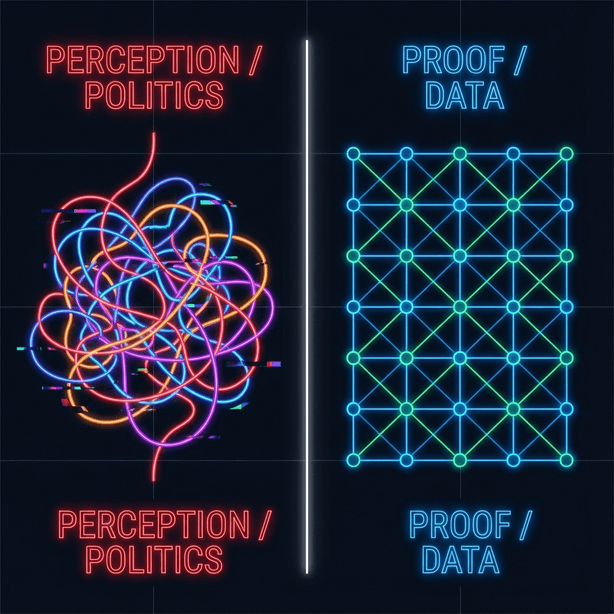
Perception rewards the loudest voice; proof rewards the best work.
Why This Law Matters
In most organizations, "success" is a negotiated narrative. Who gets the promotion? Who gets the budget? Often, it’s the person who tells the best story, sends the most visible emails, or manages up the most effectively.
This creates a toxic incentive structure. If Perception is the currency of value, ambitious employees will invest their energy in managing perception rather than generating value. They will hoard information, take credit for collective work, and engage in "shadowboxing"—fighting imaginary political battles instead of solving customer problems.
When perception rules, the quiet high-performers leave, and the loud low-performers climb. The result is an organization that feels busy but produces little, where "politics" isn't just an annoyance—it's the operating system.
The GFE Interpretation
Growth Flow Engineering (GFE) views this not as a "culture" problem, but as a data problem. Politics is simply what happens when you have an information vacuum regarding who is doing what.
Law 3 asserts that Proof of Activity must be the atomic unit of trust.
- Without Proof: Trust is a leap of faith. You have to "believe" someone is working.
- With Proof: Trust is a default state. You can see the work.
This connects directly to Law 2 (ValueLogs). ValueLogs provide the raw data—the MRI scan of execution. Law 3 is the cultural application of that data.
When you enforce Law 3, you flip the incentive structure. You stop rewarding the "Loudest Voice" and start rewarding the "Clearest Proof." This lowers your Internal Risk Index (IRI) because you are no longer making decisions based on charisma or confidence, but on verifiable reality.

The Underlying Physics of the Law
1. The Trust Gap
PwC’s 2024 Trust Survey reveals a massive gap: 86% of executives highly trust their employees, but only 60% of employees feel trusted. This gap exists because trust is invisible. Proof bridges the gap. When an employee submits a ValueLog with "Proof of Activity" (a link to a commit, a doc, a design), they aren't just reporting work; they are manufacturing trust.
2. The Meritocracy Paradox
Research shows that organizations that simply declare themselves meritocratic actually show more bias in promotions and pay. Why? Because without data, "merit" becomes subjective. It becomes "who I like" or "who reminds me of myself." Law 3 forces merit to be defined by Proof, removing the subjective filter of the manager.
3. The Velocity of Truth
In a perception-based org, bad news travels slow (everyone hides it) and good news travels fast (everyone claims it). In a proof-based org, reality travels instantly. If a project is stalled, the ValueLogs show it immediately. This allows for Bounce-Back Time (Law 9) to be minimized. You can't fix what you can't see.
Evidence From Research
- Office Politics Kills Productivity: According to a study in the Journal of Applied Psychology, office politics is a primary driver of employee stress and disengagement, with 42% of employees in highly political environments reporting active disengagement (Gallup). Law 3 eliminates the oxygen for politics by replacing "opinion" with "proof."
- The "Meritocracy Paradox": MIT Sloan research indicates that organizations explicitly promoting meritocracy often exhibit higher bias against women and minorities because managers stop self-scrutinizing. GFE counters this by requiring Proof of Activity—objective evidence—rather than subjective reviews.
- Transparency Drives Trust: Deloitte’s 2024 Human Capital Trends report found that 86% of leaders acknowledge a direct link between transparency and trust. Law 3 operationalizes transparency, moving it from a "value" to a "workflow."
How This Law Transforms Execution
When you switch from Perception to Proof, the "vibe" of the company changes instantly.
- Meetings Shrink: You don't need a status meeting to "feel" if people are working. You check the ValueLogs.
- Quiet Performers Rise: The engineer who never speaks up but ships critical code every day becomes visible. The "political operator" who talks a big game but ships nothing is exposed.
- Anxiety Drops: Employees no longer worry, "Does my boss know I'm working?" The proof is there. They are liberated from the burden of self-promotion.
- Automation Becomes Safe: You cannot automate what you cannot see. By demanding proof, you create the dataset needed for Law 6 (Audit -> Align -> Automate).
Case Example: The "Black Box" Marketing Team
Context: A Series B Fintech company had a 12-person marketing team that was "always busy" but missed every lead target.
The Struggle: The CMO was a master storyteller. Every board meeting was a dazzle of slide decks and "brand awareness" narratives. But CAC was rising, and volume was flat. The CEO couldn't fire them because "they work so hard," but couldn't fix it because he didn't know what they were doing.
The Violation: The CEO was managing based on Perception (the CMO's slides), not Proof.
The Intervention: We implemented Law 3. We required ValueLogs for the marketing team. Every activity needed a "Proof of Activity" link—a campaign URL, a draft copy doc, a design file.
The Reveal: The ValueLogs revealed that 60% of the team's time was spent on "Internal Alignment" meetings and "Brand Strategy" decks. Only 15% was spent on shipping campaigns. The "busy-ness" was real, but it was internal busy-ness.
The Result: The CEO cut the team to 6 people, refocused them on shipping (Proof), and lead volume doubled in 90 days. The "Black Box" was opened, and the politics evaporated.
How to Apply This Law Today
You don't need new software to start. You need a new standard for "Done."
- Redefine "Done": A task is not done until it has a URL. No URL, no done.
- Audit Your "Stars": Look at your "top performers." Are they top performers because of their output, or their visibility? Demand proof.
- Kill Status Meetings: Replace the "round robin" update with a review of the Proof of Activity. "Don't tell me what you did. Show me the link."
- Normalize "I Don't Know": In a proof-based culture, it's okay to say "I don't know, let me check the data." It is not okay to make up a story.
Signs You Are Violating This Law
- The "Hollow Star": You have people who are promoted rapidly but no one can point to a specific thing they built.
- The "Black Box" Department: You have a team (often Engineering or Marketing) where money goes in, but you aren't sure what comes out.
- Status Report Theater: You spend hours preparing slides about work instead of doing the work.
- Hero Worship: You rely on "heroes" to save projects at the last minute, rather than reliable systems.
How This Law Links to Valuation
Law 3 is a direct lever for ValuationOps.
- Lowers Internal Risk (IRI): Politics is a risk factor. It creates volatility. Proof creates stability. Lower volatility = Lower WACC.
- Increases Efficiency: When you stop paying for "perception management" (meetings, decks, politics), your OpEx efficiency improves.
- Scalability: You can scale Proof. You cannot scale Perception (it requires human proximity).
Investors pay a premium for predictability. A company run on Proof is predictable. A company run on Perception is a gamble.
Closing Narrative
We live in an age of infinite noise. The natural entropy of an organization is towards politics and perception.
Law 3 is the energy you inject to reverse that entropy. It is the commitment to truth over comfort. It is the understanding that the only thing that compounds is reality.
Don't let your company be a story. Make it a fact.
Proof beats perception. Every time.