

Law 3: Proof Beats Perception
The Law in One Sentence
Perception rewards the loudest voice; proof rewards the clearest reality.
Why This Law Matters
Most organizations say they reward performance. In practice, many still reward visibility, narrative control, or political fluency.
That creates a predictable failure mode:
- quiet operators become invisible
- noisy operators become over-credited
- leadership decisions drift away from actual work
- trust becomes personality-based instead of evidence-based
Law 3 exists to move the operating culture toward proof.
The GFE Interpretation
Inside GFE services, proof is not a philosophical ideal. It is an operating requirement.
We use proof-bearing work records to reduce the gap between:
- what people say happened
- what actually happened
- what leadership can confidently act on
This is where Law 3 connects to Law 2. ValueLogs make execution legible. Law 3 explains what that visibility does to incentives and trust.
This Website is not the constitutional owner of proof semantics. For the canonical GFE definitions, use the Skill Spec package:
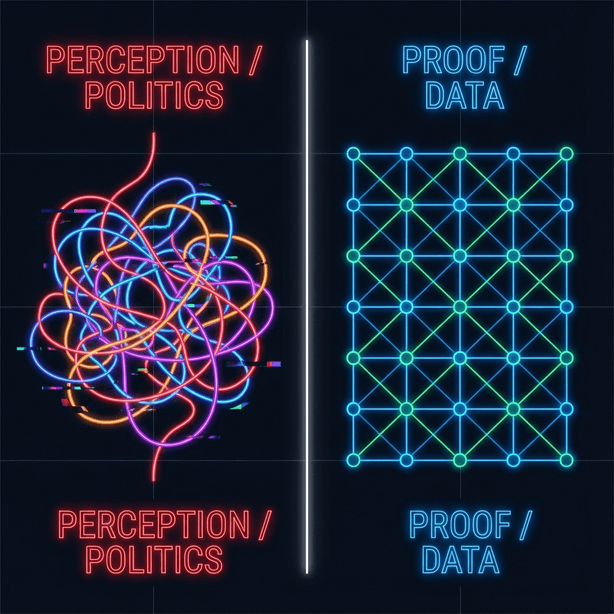
What changes when proof becomes normal
- Politics loses leverage. Work is easier to inspect, so perception games matter less.
- Trust gets cheaper. Leaders no longer need to infer reality entirely from confidence or responsiveness.
- Quiet performers become visible. Evidence surfaces contribution without requiring self-promotion theatre.
- Risk falls. Decisions rely less on story and more on inspectable operating truth.
Today, next, later
Today
In services work, proof improves accountability, redesign quality, and governance conversations.
Next
The same proof logic supports operator infrastructure such as baseline, evidence challenges, and public proof profiles.
Later
Validation, verification, and certification may turn evidence into stronger trust layers. That is future infrastructure, not present-tense proof that this Website provides.
Case example: the black-box marketing team
A fintech leadership team believed marketing was high-effort but low-output. Every board update was persuasive, but conversion and volume lagged.
When the team shifted to proof-bearing records during the engagement, the actual pattern emerged: too much time was going into internal alignment, approval loops, and deck production instead of campaign shipment.
The issue was not that the team was lazy. The issue was that leadership had been governing through perception instead of evidence.
How to Apply This Law Today
- Redefine what counts as done. Important work should have inspectable proof.
- Review evidence before opinion. Start decision conversations from what exists, not who sounds most certain.
- Use proof to improve systems, not to punish noise. The point is better operating design.
- Separate evidence from stronger trust claims. Proof is not the same as validation or certification.
Closing Narrative
Perception is cheap. Proof is disciplined.
Law 3 matters because organizations that cannot distinguish the two eventually reward theatre over value creation.