

McKinsey 7S Model for Culture + Execution Alignment
Strategy and automation both fail when structure, people, and culture pull in different directions. The McKinsey 7S model helps make misalignment visible before leadership tries to scale it.
1. What It Is
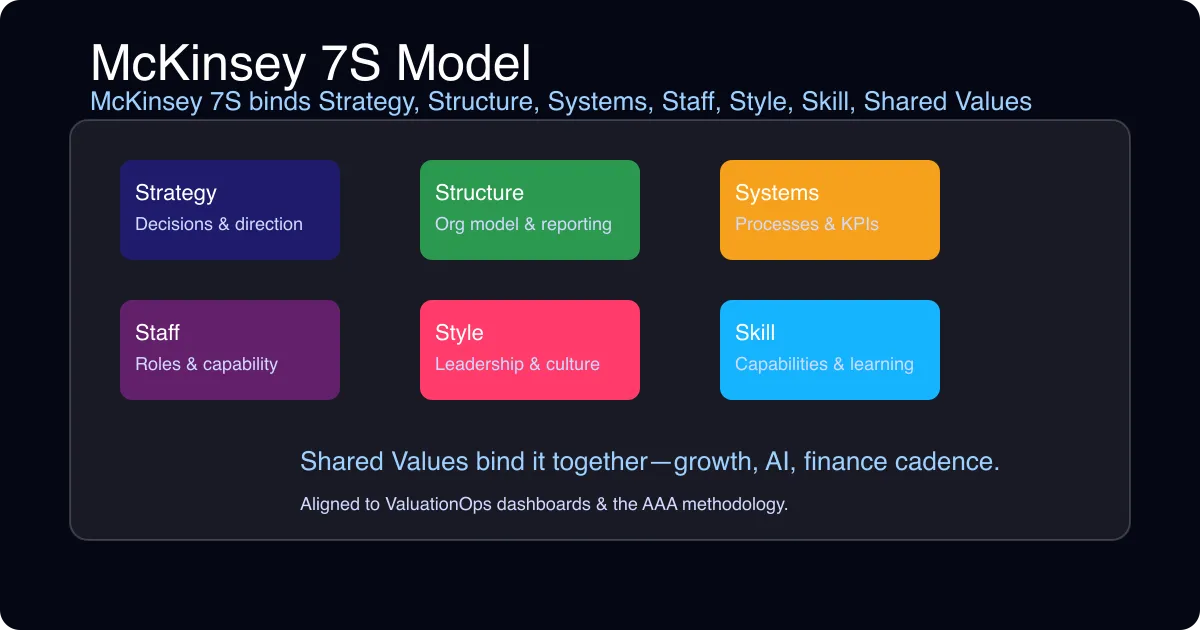
The 7S model is a coherence check. It asks whether strategy, structure, systems, staff, style, skill, and shared values are actually reinforcing one another.
Inside GFE work, that matters because many AI transformation efforts fail long before the tooling fails. They fail because leadership, incentives, governance, and operating design do not agree on what the system is supposed to do.
2. Why we use it
We use the 7S model as an Align-stage diagnostic, not as generic corporate theater.
It helps us surface where:
- leadership wants speed but governance still rewards delay
- structure blocks the workflow the strategy depends on
- systems are modernized while incentives remain old
- skill gaps are treated as tooling gaps
- shared values say one thing while operating habits do another
3. GFE interpretation
The 7S model becomes useful when it is paired with execution evidence and business priorities.
That means:
- Strategy should map to real value bets
- Systems should support the workflow leaders claim to want
- Style and Shared Values should reinforce the same behaviors the operating model depends on
- Skill should be discussed as capability readiness, not title inflation
Where evidence or trust semantics matter, this Website stays conceptual. Skill Spec remains the canonical source for trust-layer and evidence definitions:
4. Walkthrough
| S | What it represents | Why it matters in GFE work |
|---|---|---|
| Strategy | Direction and value bets | Prevents automation without a business thesis |
| Structure | Reporting lines and accountability | Determines whether the work can actually flow |
| Systems | Processes, tools, governance | Makes good intent executable or blocks it |
| Staff | Capacity and role coverage | Reveals where ownership is thin or overloaded |
| Style | Leadership behavior | Signals what the organization really rewards |
| Skill | Capability readiness | Shows whether teams can execute the change being proposed |
| Shared Values | Norms and operating identity | Determines whether the redesign will stick |
5. Example
Imagine a finance team with a strong strategic push toward AI-assisted planning, but regional silos, outdated planning systems, and leadership habits that still reward manual reporting heroics.
The issue is not just tooling. It is 7S misalignment:
- strategy says "move faster"
- structure says "ask three regions first"
- systems say "export and reconcile manually"
- style says "bring me a deck, not the operating evidence"
A 7S pass makes those contradictions visible before more software is layered on top.
6. Today, next, later
Today
Inside GFE services, the 7S model helps leadership teams align culture, process, and operating design before they automate.
Next
A stronger operator infrastructure can make capability and trust layers more inspectable across the same organization.
Later
Validation and certification may give stronger external trust signals about who can run these systems well. That is future infrastructure, not the current claim of this page.
7. Takeaways
- do not treat culture as soft background noise
- do not automate over leadership contradictions
- do not confuse a tooling problem with an alignment problem
- use structure, style, and systems together when diagnosing execution failure
Closing
When culture and operating design point in different directions, software just scales the contradiction.
That is why 7S still matters. It forces leadership to align the human system before it asks the machine system to move faster.
Next step: Explore the AAA Transformation Launchpad