

Law 5: Friction Is the Enemy. Flows Are the Strategy.
The Law in One Sentence
Friction is the invisible tax on velocity; Flows are the strategic removal of that tax to enable scalable performance.
Why This Law Matters
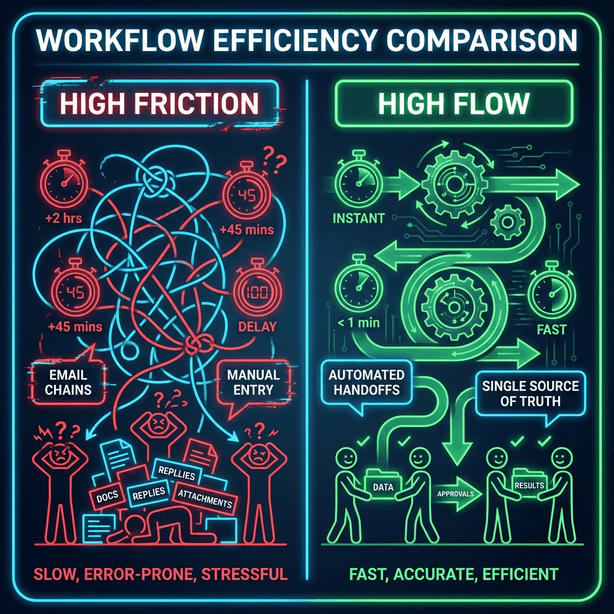
In physics, friction is the force resisting motion. In business, Friction is anything that makes a task harder than it needs to be. It’s the login screen that times out, the approval email that sits in an inbox for 3 days, the data that has to be copied from one spreadsheet to another manually.
Most organizations try to solve performance problems by adding force (hiring more people, working longer hours). Law 5 states that it is infinitely cheaper and more effective to remove friction.
If you add force to a high-friction system, you just generate heat (burnout). If you remove friction, you generate velocity (flow).
The GFE Interpretation
We don't use "Processes" in the traditional sense; we use Flows. A Process is often a static document nobody reads. A Flow is a living map of value delivery.
To defeat friction, you must map the Value Stream. A GFE Flow Map identifies six specific layers of friction:
- People: Who is doing the work? Are they context-switching?
- Process: What are the steps? Are there loops or dead ends?
- Tools: Are the tools integrated, or are we copy-pasting?
- Decisions: Who has to say "yes"? Is that person a bottleneck?
- Metrics: How do we know it's working? Are we flying blind?
- Dependencies: Who are we waiting for?
AI cannot fix friction. If you automate a high-friction process with AI, you just scale the chaos. You must smooth the flow before you apply the engine.
The Underlying Physics of the Law
1. The Theory of Constraints
Eliyahu Goldratt’s famous theory states that every system has one constraint (bottleneck) that limits its total output. Improving anything other than that constraint is an illusion. Friction is usually that constraint. If your developers spend 40% of their time fighting bad dev environments, hiring more developers won't help. Fixing the environment will.
2. Cognitive Load Theory
Friction consumes "working memory." Every time an employee has to search for a file, remember a password, or ask "who approves this?", they burn cognitive energy. This leaves less energy for the actual work (solving problems). High friction = Low IQ organization.
3. Entropy
Systems naturally degrade towards disorder (entropy). Friction is the symptom of entropy. Without active energy input (Org-Building from Law 4) to clean up processes, friction will always increase until the system grinds to a halt.
Evidence from Research
- The Cost of Friction: A report by HBR suggests that "organizational drag" costs the economy over $3 trillion per year. Knowledge workers spend up to 41% of their time on discretionary activities that offer little personal satisfaction and could be handled by others (or automation).
- The ROI of Flows: Forrester found that implementing Value Stream Management (VSM) tools and practices delivered a 471% ROI over three years. Why? Because seeing the friction allows you to kill it.
- The Employee Experience: 92% of employees say they experience workplace friction, with "ineffective communication" and "overly complicated processes" being top offenders. This is the #1 driver of turnover.
How This Law Transforms Execution
Applying Law 5 changes your strategy from "Add Resources" to "Remove Obstacles".
- The "Stop Doing" List: The fastest way to increase velocity is to stop doing low-value work. Flows reveal steps that add no value (waste). Cut them ruthlessly.
- Asynchronous by Default: Meetings are high-friction synchronization points. Flows encourage async handoffs (documentation, tickets) so people can work without waiting.
- Single Source of Truth: Data fragmentation is friction. Flows demand that every piece of data lives in one place that everyone can access.
- The "Golden Path": For common tasks (e.g., deploying code, onboarding a client), create a paved road with zero friction. Make the right way the easiest way.
Case Example: The "Approval Queue of Death"
Context: A marketing agency was missing deadlines. The creative team blamed the account managers; account managers blamed the clients.
The Struggle: Everyone was working late. The CEO wanted to hire a "Traffic Manager" to coordinate the chaos (adding force).
The Violation: We mapped the Flow. We found that every piece of content required 4 separate approvals via email. If one person didn't reply, the chain broke. The average "Wait Time" was 4 days; the "Work Time" was 4 hours.
The Intervention: We removed the friction.
- Consolidated Decisions: Approvals were moved to a single Slack channel with automated reminders.
- Reduced Steps: We cut one approval layer entirely (empowered the Senior Designer).
- Tool Integration: The design tool pushed status updates directly to the project management tool.
The Result: Turnaround time dropped from 5 days to 1.5 days. No new hires needed. The "Traffic Manager" salary was saved.
How to Apply This Law Today
- Map One Flow: Pick one process that feels painful (e.g., "New Client Onboarding").
- Measure Wait vs. Work: For that process, measure how much time is spent working vs. waiting. (The ratio is often shocking, like 10% work / 90% wait).
- Kill One Step: Find one approval, one form field, or one meeting that doesn't add value. Kill it.
- Automate the Handoff: Use a tool (Zapier, Make) to move data from Step A to Step B automatically.
Signs You Are Violating This Law
- "Reply All" Hell: Critical information is buried in email threads.
- The "Shoulder Tap": You have to physically ask someone to know the status of a project.
- Shadow IT: Teams are buying their own tools because the official ones are too painful to use.
- Heroics: Deadlines are met only because someone pulled an all-nighter to overcome the system's inefficiencies.
How This Law Ties to Valuation
Law 5 drives Scalability.
Investors pay a premium for businesses that can scale revenue without scaling headcount linearly.
- High Friction: To double revenue, you must double headcount. (Low Margin, Low Multiple).
- High Flow: To double revenue, you add zero headcount. You just pour more fuel into the engine. (High Margin, High Multiple).
Friction is the ceiling on your valuation. Flows break through it.
Closing Narrative
Imagine driving a Ferrari with the handbrake on. You can push the gas pedal to the floor (work harder). You can put a better driver in the seat (hire talent). You can put high-octane fuel in the tank (raise capital). But you will still burn out the engine and move slowly.
The strategic move is not to push harder. It is to release the brake.
Friction is the enemy. Flows are the strategy.