

Law 6: Audit First. Align Second. Automate Last.
The Law in One Sentence
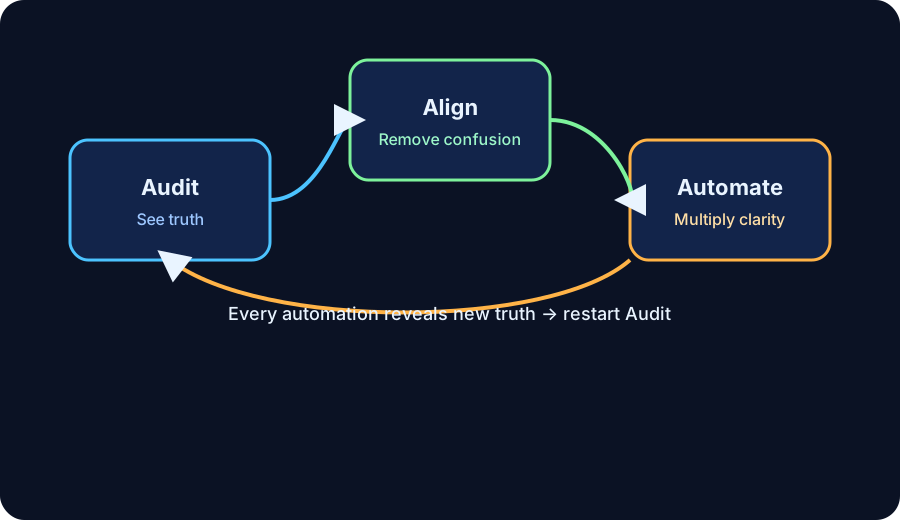
Automation applied to chaos multiplies chaos; the AAA loop is strict: Audit reveals truth, Align removes confusion, Automate multiplies clarity.
Why This Law Matters
Most organizations treat automation like a silver bullet. "Our sales team is slow? Automate it." "Support tickets are piling up? Automate it." "Marketing isn't converting? Automate it."
The result? 70% of automation projects fail.
Why? Because they automate before they understand what they're automating. They skip the unglamorous work of auditing the current state and aligning stakeholders, jumping straight to the sexy part: the robot.
But automation is not a fixer. Automation is a multiplier. If you feed it a broken process, it will break faster and at scale. If you feed it a misaligned team, it will amplify the misalignment. If you feed it clarity, it will scale clarity.
Law 6 forces a strict order: Audit → Align → Automate. Skip a step, and you pay the price in wasted time, money, and trust.
The GFE Interpretation
The AAA Loop is not optional. It is a forcing function to prevent the most common mistake in transformation: optimizing the wrong thing.
1. Audit: Reveal the Truth
Before you can fix anything, you must see it clearly. An Audit is the act of mapping reality without bias.
In GFE, an Audit means:
- Mapping the Flow (from Law 5): Where does the work flow? Who touches it? What tools are involved?
- Capturing ValueLogs (from Law 2): What is the actual time spent? What is the LEO breakdown?
- Documenting Proof (from Law 3): What evidence exists that this process works—or doesn't?
The Audit reveals the gap between what you think is happening and what is actually happening. This gap is usually massive.
2. Align: Remove Confusion
You cannot automate a process if stakeholders disagree on what the process is. Alignment is the act of creating a shared mental model.
In GFE, Align means:
- Consensus on the Flow: Everyone agrees on the canonical version of the process.
- Consensus on the Metrics: Everyone agrees on what "success" looks like.
- Consensus on the Why: Everyone understands why this process exists and what value it delivers.
Misalignment is invisible until you try to automate. Then it explodes. Sales wants one thing, Marketing wants another, and the automation does neither.
3. Automate: Multiply Clarity
Only after you have audited reality and aligned stakeholders can you safely automate. At this stage, automation is no longer risky—it's inevitable.
In GFE, Automate means:
- Codifying the Flow: Turning the agreed-upon process into software, rules, or AI agents.
- Monitoring with Proof: Ensuring the automation generates Proof of Activity so you can verify it's working.
- Iterating the Loop: Automation reveals new insights (e.g., edge cases, bottlenecks), which triggers a new Audit.
The AAA Loop is continuous. Each automation surfaces new truths, which requires a new audit.
The Underlying Physics of the Law
1. Garbage In, Garbage Out (GIGO)
This is the foundational principle of computing. If you feed a system bad inputs, it will produce bad outputs—reliably and at scale. Automation is a system. If you automate a broken process (Garbage In), you get broken results faster (Garbage Out).
2. Observability Precedes Optimization
You cannot improve what you cannot measure. The Audit step creates observability (visibility into the system). Without it, you're flying blind. Optimization without observation is guesswork.
3. Conway's Law
Organizations design systems that mirror their communication structures. If your teams are misaligned (siloed, political, confused), your automation will reflect that misalignment. The Align step breaks Conway's Law by forcing cross-functional consensus before building the system.
Evidence from Research
- The Cost of Premature Automation: Studies show that 30-50% of RPA (Robotic Process Automation) projects fail globally, often because they automate unoptimized processes. Companies rush to deploy bots on broken workflows, multiplying inefficiency instead of eliminating it.
- The Alignment Tax: 44% of projects fail due to misalignment with business objectives. Without explicit alignment, teams build automation that solves the wrong problem or creates new friction.
- The ROI of Auditing: Organizations that conduct thorough process audits before automation report significantly higher ROI. Audits identify bottlenecks and waste, ensuring automation targets high-impact areas rather than automating low-value tasks.
How This Law Transforms Execution
Applying Law 6 changes the conversation from "What should we automate?" to "What should we audit?"
- The Pre-Mortem: Before automating, run a pre-mortem. Ask: "If this automation fails, what went wrong?" Usually, the answer is "We didn't audit" or "We weren't aligned."
- The Alignment Workshop: Before writing a single line of code, gather stakeholders and map the process together. If they can't agree on the current process, they won't agree on the automated one.
- The Proof Requirement: Before automating, define what "Proof of Success" looks like. If you can't measure success manually, you can't automate it.
- The Iteration Cadence: Treat each automation as a mini-experiment. Automate small, audit the results, align on learnings, then automate more.
Case Example: The "Automated Chaos Machine"
Context: A SaaS company wanted to automate customer onboarding. They hired a vendor to build a no-code automation platform. Six months and $200K later, the system was live.
The Struggle: Customer complaints increased. The automation sent the wrong emails, skipped critical steps, and confused customers. The sales team bypassed the system entirely, reverting to manual onboarding.
The Violation: They skipped Audit and Align. They never mapped the actual onboarding flow—they mapped the ideal flow from a 2-year-old slide deck. Sales, Support, and Product had different mental models of onboarding, but no one aligned them. The automation reflected the CEO's outdated vision, not reality.
The Intervention: We paused all automation. We ran a 2-week Audit: shadowed sales calls, reviewed support tickets, captured ValueLogs from onboarding specialists. We discovered the real process had 3 major variants depending on customer type—none of which were in the slide deck.
We then ran an Align workshop: Sales, Support, Product, and Customer Success mapped the actual flows together. They agreed on one canonical flow per customer type. Only then did we re-automate.
The Result: The new automation worked. Onboarding time dropped 40%. Complaints dropped 60%. The system was finally automating reality, not fantasy.
How to Apply This Law Today
- Pick One Process to Audit: Choose a process you want to automate. Before touching any automation tool, spend 1 week auditing it. Shadow the people doing the work. Map the actual steps. Capture ValueLogs.
- Run an Alignment Session: Gather everyone involved in the process. Show them your audit findings. Ask: "Is this accurate?" Resolve disagreements now, not after you've built the automation.
- Define Success Metrics: Before automating, write down: "This automation succeeds if ___." If you can't fill in that blank clearly, you're not ready to automate.
- Start Small: Automate one step of the process. Measure the results. If it works, automate the next step. If it doesn't, re-audit.
Signs You Are Violating This Law
- The "Set It and Forget It" Mindset: You deploy automation and assume it will work forever without monitoring or iteration.
- The "Frankenstein System": Your automation duct-tapes together 5 different tools because no one agreed on a unified approach.
- The "Silent Failure": Your automation breaks, but no one notices for weeks because there's no Proof of Activity being captured.
- The "Automation Theater": You automated something just to say you automated it, but it doesn't actually save time or improve quality.
How This Law Ties to Valuation
Law 6 drives Operational Leverage.
Investors value companies that can scale output without scaling inputs linearly. Automation is the ultimate lever—if done right.
- Bad Automation: Requires constant babysitting, breaks frequently, and alienates customers. (Negative leverage.)
- Good Automation: Runs reliably, scales infinitely, and delights customers. (100x leverage.)
The AAA Loop is the difference between bad automation and good automation. Companies that master the AAA Loop can scale 10x without 10x-ing headcount.
Closing Narrative
Imagine you're building a house. You could start by buying bricks and stacking them as fast as possible (Automate First). But without a blueprint (Audit) or agreement on what the house should look like (Align), you'll build a pile of bricks, not a house.
Or, you could hire an architect to survey the land (Audit), design the house with all stakeholders (Align), and then bring in the construction crew to build it efficiently (Automate).
The house built with AAA will stand for decades. The pile of bricks will collapse.
The same is true for your operations.
Audit first. Align second. Automate last.