

Law 8: Reduce Internal Risk, Reduce WACC, Increase Enterprise Value
The Law in One Sentence
Internal operational risk is a tax on your cost of capital—reduce it, and investors pay less for risk, which means you pay less to raise money, which increases enterprise value.
Why This Law Matters
Most companies think about valuation as a function of revenue, profit, or growth. They miss the biggest lever: risk.
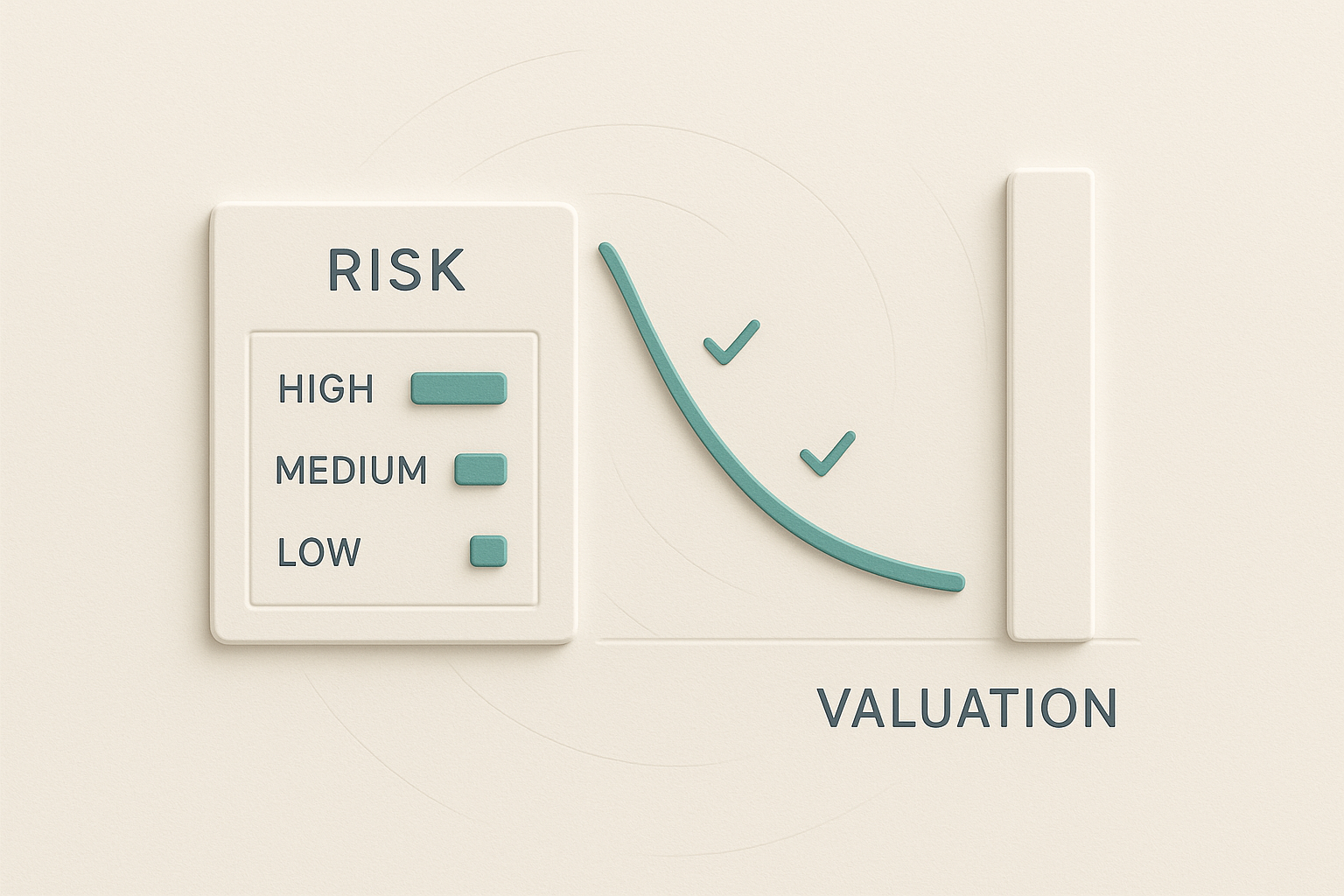
When investors or lenders evaluate your company, they're asking: "How likely is this business to blow up?" The more likely it is to fail (high risk), the more they charge you for their money (high cost of capital). The less likely (low risk), the less they charge (low cost of capital).
Law 8 makes this explicit:
- High internal risk → High WACC → Low enterprise value
- Low internal risk → Low WACC → High enterprise value
Internal risk isn't "market risk" (things outside your control). It's operational risk—the chaos inside your business: undocumented processes, key person dependencies, manual workflows, inconsistent execution.
This is the only type of risk you can actually control. And when you reduce it, the financial markets reward you immediately.
The GFE Interpretation
The Risk→Cost→Value Chain
In GFE, we model this as a three-step chain:
1. Internal Risk (The Source)
Internal operational risk is the probability that your business underperforms or fails due to your own execution problems, not market conditions.
Examples of high internal risk:
- "Only Sarah knows how to run the billing process."
- "Our deployment pipeline breaks 40% of the time."
- "We have no visibility into customer churn until it's too late."
- "Revenue recognition is done manually in Excel."
These aren't theoretical risks—they're measurement problems. If you can't prove your processes work reliably, investors assume they don't.
2. WACC (The Transmission Mechanism)
WACC (Weighted Average Cost of Capital) is the blended cost of your equity and debt financing. It's what you pay to raise $1.
WACC = (E/V × Re) + (D/V × Rd × (1 - Tc))
Where:
- Re = Cost of Equity (what shareholders demand)
- Rd = Cost of Debt (what lenders charge)
- E/V = % equity
- D/V = % debt
- Tc = Tax rate
Both Re and Rd increase with internal risk:
- Cost of Equity (Re): Shareholders demand higher returns to compensate for uncertainty. If your business is unpredictable (high operational risk), they want a higher equity risk premium.
- Cost of Debt (Rd): Lenders charge higher interest rates when they see execution risk. If you can't prove your processes are stable, you look like a default risk.
Result: Higher internal risk → Higher WACC.
3. Enterprise Value (The Outcome)
Enterprise value is the present value of all future cash flows, discounted by WACC.
EV = Σ (Cash Flow / (1 + WACC)^t)
When WACC goes up, EV goes down. Even if cash flows stay the same, a higher discount rate = lower valuation.
Example:
- Company A has $10M annual cash flow and WACC of 8% → EV = $125M
- Company B has $10M annual cash flow and WACC of 12% (higher risk) → EV = $83M
Same cash flow. 40% lower valuation. The only difference: internal risk.
The Underlying Physics of the Law
1. The Risk Premium Hypothesis
Investors are risk-averse. They demand compensation (premium) for uncertainty. Internal operational risk creates cash flow uncertainty, which raises the risk premium embedded in both Re and Rd. The formula is brutal: Every 1% increase in WACC can reduce valuation by 10-20% depending on growth stage.
2. The Information Asymmetry Tax
When you can't prove your operations are stable (no Proof, no documented Processes), investors assume the worst. This asymmetry (you know more than they do) gets priced as extra risk. Reducing this asymmetry (via transparency) lowers WACC.
3. The Compounding Effect of Risk Reduction
Reducing internal risk doesn't just lower WACC—it also makes cash flows more predictable, which can justify higher multiples. You get a double lift: lower discount rate + higher confidence in projections = exponential value increase.
Evidence from Research
Internal risk increases WACC: Strategic and operational risks directly increase both the cost of equity (through higher beta and equity risk premium) and the cost of debt (through credit downgrades and default risk premiums). When companies face execution uncertainty, investors demand higher returns to compensate.
Operational risk reduction increases enterprise value: Research shows that addressing operational deficiencies (leadership gaps, inefficient processes, poor safety practices) can unlock 15-20% additional value in private equity-backed companies. Effective operational risk management leads to more stable cash flows and justifies lower discount rates.
Process documentation reduces perceived risk: Well-documented businesses receive higher valuations during M&A because they reduce buyer uncertainty. Process documentation demonstrates operational control, ensures business continuity, and accelerates due diligence—all of which lower the perceived risk and increase what buyers are willing to pay.
How This Law Transforms Execution
Applying Law 8 changes how you think about "operational improvements." They're not just efficiency plays—they're valuation plays.
Before Law 8:
- CFO: "We need to document our processes."
- COO: Shrugs. "That's busy work. We have revenue goals."
After Law 8:
- CFO: "Our WACC is 12%. Industry average for low-risk companies is 8%. That 4-point gap is costing us $20M in enterprise value."
- COO: "What drives that 4-point gap?"
- CFO: "Operational risk. Investors flagged: undocumented processes, key person dependencies, and no Proof of Activity."
- COO: "Got it. If we document processes, reduce dependencies, and generate proof, we lower WACC and add $20M in value?"
- CFO: "Exactly. And it's cheaper than trying to grow revenue by $20M."
Case Example: The "$15M WACC Reduction"
Context: A SaaS company raising a Series B. During investor diligence, the lead investor flagged "high execution risk":
- Revenue recognition was manual (Excel).
- Customer success had no documented playbook.
- Only 2 people understood the billing system.
- No automated compliance reporting.
The Penalty: Investor offered a term sheet at a $50M valuation with a 15% hurdle rate (WACC proxy). The CEO expected $65M at 10%.
The Violation: They violated Law 8. Their internal operational risk was so high that investors priced in a 5-point risk premium.
The Intervention: We ran a 4-week Internal Risk Audit:
- Documented Processes (from Law 5 & Law 6): Mapped and documented revenue recognition, customer success, billing, and compliance workflows.
- Built Proof Engines (from Law 3): Automated compliance reporting and billing audit trails.
- Reduced Key Person Risk: Cross-trained 4 additional people on billing; created runbooks.
- Connected to KPIs (from Law 7): Showed how each process mapped to revenue accuracy and retention metrics.
The Result: Returned to the investor with a "Risk Mitigation Deck." The investor revised the term sheet: $62M valuation at 11% hurdle rate.
Net impact: $12M higher valuation + 4-point WACC reduction = $15M+ value unlocked in 4 weeks.
How to Apply This Law Today
- Calculate Your Current WACC: If you don't know your WACC, you're flying blind. Use your last funding round's terms or industry benchmarks.
- Identify Internal Risk Drivers: Ask investors/lenders: "What operational risks concern you?" Common answers: key person dependencies, manual processes, lack of SOPs, no audit trail.
- Quantify the Risk Tax: For every 1% of WACC driven by internal risk, calculate the enterprise value loss. (Hint: It's usually 10-15% of EV per WACC point.)
- Run a Risk Reduction Sprint:
- Communicate to Market: Show investors the before/after. Prove you've de-risked. Watch WACC drop.
Signs You Are Violating This Law
- The "Only I Know" Syndrome: Critical processes live in one person's head.
- The Manual Chaos: Revenue, compliance, or reporting is done manually, with no audit trail.
- The Visibility Gap: Leadership can't prove how core processes work or that they work reliably.
- The Investor Discount: Investors offer lower valuations or higher interest rates "because of execution risk."
How This Law Ties to Valuation
Law 8 is the most direct law in the Canon when it comes to valuation.
While other laws improve valuation indirectly (by boosting revenue, margins, or efficiency), Law 8 operates on the discount rate itself—the denominator in every valuation formula.
Lower WACC = Higher Valuation. Period.
And internal risk is the only component of WACC you fully control. You can't control market risk, regulatory risk, or macro risk. But you can control whether your billing process is documented, whether there's proof of compliance, and whether your business can run without you.
Companies that master Law 8:
- Raise capital at better terms (lower dilution, lower interest).
- Command higher exit multiples (buyers pay premiums for low-risk businesses).
- Scale confidently (low operational risk = predictable execution).
Closing Narrative
Imagine two identical factories. Both produce $10M/year in profit. Same product, same market, same customers.
Factory A:
- Processes are undocumented. Only the founder knows how things work.
- Operations are manual. Errors happen weekly.
- No audit trail. Compliance is "trust us."
Factory B:
- Every process is documented and repeatable.
- Operations are semi-automated with full proof trails.
- Compliance is real-time and auditable.
An investor values Factory A at $50M (20% WACC). An investor values Factory B at $100M (10% WACC).
Same profit. Double the valuation. The difference: internal risk.
Reduce Internal Risk. Reduce WACC. Increase Enterprise Value.