

Law 10: Story Drives Valuation
The Law in One Sentence
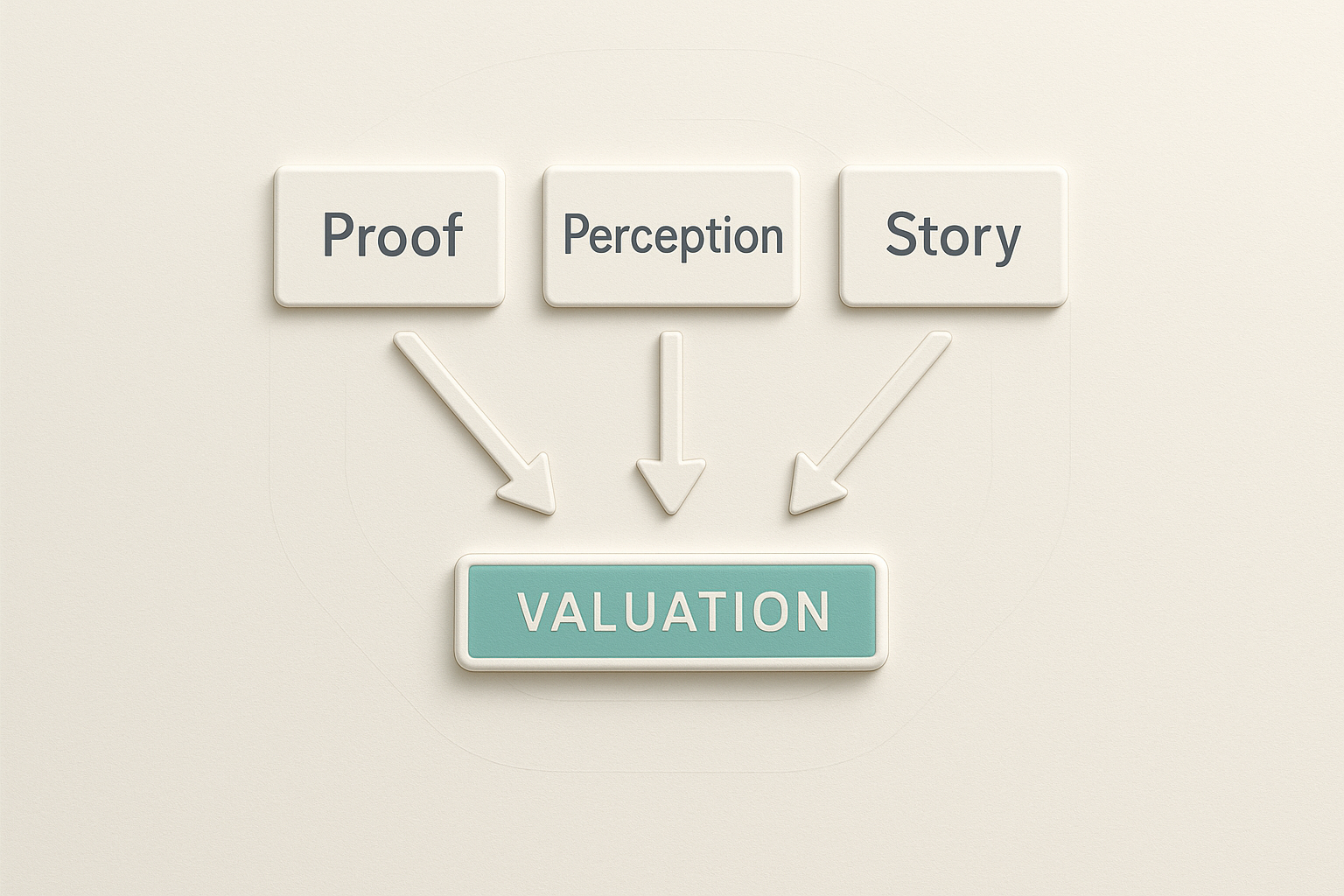
Markets don't buy numbers—they buy the story behind the numbers. When proof and narrative align, companies command premium valuations. When they diverge, markets punish.
Why This Law Matters
You can have perfect metrics, immaculate Proof, and flawless Processes—but if you can't tell a coherent story about why those numbers exist and where they're going, you'll get discounted.
Law 10 states: Story is the interface between reality and value.
Investors, customers, and employees don't just respond to data. They respond to the narrative that gives data meaning:
- Where did we come from? (Origin story)
- Why do we exist? (Mission)
- What problem do we solve? (Value proposition)
- How are we different? (Differentiation)
- Where are we going? (Vision)
Companies with strong narratives get:
- Higher valuation multiples (investors pay a premium for clarity)
- Lower cost of capital (lenders trust the vision)
- Better customer retention (people buy into the story, not just the product)
- Stronger employee engagement (teams rally around a shared narrative)
Companies with weak or inconsistent narratives get:
- Discounted valuations (uncertainty = risk premium)
- Higher churn (customers don't connect emotionally)
- Talent flight (employees don't see the bigger picture)
StoryOps is the practice of aligning internal proof with external perception—ensuring that what you say matches what you do.
The GFE Interpretation
The Story-Proof Matrix
In GFE, we model this as a 2x2 matrix:
| Strong Proof | Weak Proof | |
|---|---|---|
| Strong Story | Premium Valuation (Aligned) | Hype (Unsustainable) |
| Weak Story | Undervalued (Opportunity) | Ignored (Doomed) |
Quadrant 1: Strong Story + Strong Proof = Premium Valuation
This is the goal. Your narrative is compelling and backed by evidence. Investors believe you. Customers trust you. Employees are engaged.
Example: Tesla in 2015-2020. The story ("accelerate sustainable energy") was bold. The proof (Model S outperforming, Gigafactories scaling, software advantage) supported it. Result: Traded at 10x the multiple of traditional automakers.
Quadrant 2: Strong Story + Weak Proof = Hype
You tell a great story, but the data doesn't support it. This works temporarily (fundraising on vision), but eventually markets punish you when proof doesn't materialize.
Example: Theranos. Compelling narrative ("revolutionize healthcare"), zero proof (technology didn't work). Result: Collapse.
Quadrant 3: Weak Story + Strong Proof = Undervalued
You have great metrics, but you can't communicate why they matter. Investors undervalue you because they don't understand your growth trajectory or competitive moat.
Example: Many B2B SaaS companies with solid ARR growth but poor investor comm. Result: Lower multiples than peers with better storytelling.
Quadrant 4: Weak Story + Weak Proof = Ignored
Neither story nor metrics. Markets ignore you entirely.
The Underlying Physics of the Law
1. The Information Asymmetry Tax
Investors always know less about your business than you do. This asymmetry creates risk. Story reduces this asymmetry. A clear narrative helps investors understand how you create value, why you'll continue to do so, and what could go wrong. When the story is unclear, investors assume the worst and discount your valuation accordingly.
2. The Coherence Premium
Research shows that companies with coherent narratives (where the story aligns with financial performance) receive higher valuations. 72% of investors are more likely to support companies whose leaders effectively convey their story. Earnings calls with positive, fact-backed narratives drive higher stock returns and trading volumes.
3. The Emotional Amplifier
Humans make decisions based on both logic and emotion. A strong story creates emotional resonance—investors want to be part of the journey. This emotional connection can justify higher multiples even when the numbers alone wouldn't.
Example: Amazon vs. Walmart (2010-2020). Amazon's narrative ("customer obsession, long-term thinking, infrastructure for the future") commanded a 3-5x revenue multiple. Walmart's narrative ("low prices every day") commanded 0.5x. Similar businesses, radically different stories, radically different valuations.
Evidence from Research
Narrative drives investor confidence and valuation premiums: Companies with effective storytelling attract investors more readily. Research shows 72% of investors are more likely to support companies with clear narratives. Buy-side investors may pay a 10% premium for companies with strong investor relations while discounting those with weak IR by 20%.
Earnings call narrative quality impacts stock returns: The tone, clarity, and coherence of earnings call narratives significantly influence stock price movements and trading volumes. Positive, fact-backed narratives mitigate negative earnings surprises, while poor vocal clarity or weak narratives can suppress investor activity.
Story contextualizes financial data: Effective corporate storytelling transforms raw financial data into meaningful narratives that help stakeholders understand strategic direction, growth potential, and value creation. This transparency and context-setting differentiates companies in competitive markets and can justify premium valuations.
How This Law Transforms Execution
Applying Law 10 changes how you think about communication.
Before Law 10:
- CFO: "Our Q3 ARR grew 40% YoY."
- Investor: "Why? Is it sustainable? What's your moat?"
- CFO: Opens spreadsheet. "Let me show you the cohort data..."
- Investor: Loses interest.
After Law 10:
- CFO: "Our Q3 ARR grew 40% YoY because we've solved a unique problem: procurement teams waste 60 hours/month on manual vendor approval. We automated this with AI-driven workflows. Our Proof engine shows customers save an average of $400K/year. Our NPS is 72, and we have 95% net revenue retention. The TAM is $12B, and we're the only player with this level of automation + proof. That's why growth is sustainable."
- Investor: Leans in. "Tell me more about expansion into enterprise."
Case Example: The "$200M Narrative Gap"
Context: Two SaaS companies raising Series C. Both have $20M ARR, 3x YoY growth, 85% gross margins, and similar team sizes.
Company A (Weak Story):
- Pitch: "We're a B2B workflow automation tool. We have 300 customers and are growing fast."
- Investor Questions: "What's your differentiation? Why won't a competitor copy you? What's your growth ceiling?"
- CEO Response: "We're early. We'll figure it out."
- Valuation: $80M (4x ARR)
Company B (Strong Story + Proof Alignment):
- Pitch: "We're automating compliance workflows for fintech companies. Every fintech company spends $2M/year on manual compliance checks. We reduce that to $500K. Our customers have saved $47M YTD—we have proof systems that track this (Law 3). We've mapped every step of the compliance flow (Law 5), and our NPS is 78 (Law 7). The TAM is $8B, and we're the only player with automated audit trails. We're expanding into insurance next quarter."
- Investor Questions: "How do you ensure audit trail integrity?"
- CEO Response: Shows dashboard with real-time compliance event logs. "Every action is logged, immutable, and auditable. Here's proof from our top 10 customers."
- Valuation: $280M (14x ARR)
The Difference: $200M valuation gap. Same metrics. Different story.
Company B's CEO told a story that:
- Named the problem (compliance is expensive)
- Quantified the solution ($1.5M savings per customer)
- Provided proof ($47M saved YTD)
- Connected to processes (flow mapping)
- Showed traction (NPS 78, retention data)
- Articulated vision (expanding to insurance)
The narrative aligned with proof. Investors believed it. Premium valuation.
How to Apply This Law Today
Audit Your Current Narrative: Can you answer these in 2 minutes?
- What problem do we solve?
- Who do we solve it for?
- How are we different?
- Why will we win long-term?
- Where are we going?
Build Your Proof Engine: For every claim in your narrative, you need Proof. "We save customers time" → Show average hours saved per month. "We're differentiated" → Show churn data vs. competitors.
Align Story with Metrics: Your narrative should naturally lead to your KPIs. If your story is "we make sales teams more efficient," your KPIs should be "deals closed per rep" and "time to close." Don't tell a growth story if your metrics show churn problems.
Practice Narrative Consistency: Your CEO, CFO, and VP Sales should all tell the same story. Inconsistent narratives create doubt.
Tell the Story: Present your data as a narrative. "We were here. We did this. Now we are here."
- Update the Story as You Evolve: Your narrative in Year 1 ("we're solving X for Y") will differ from Year 5 ("we're the infrastructure for Z"). Update it. But keep it coherent.
Signs You Are Violating This Law
- The "Lost in Translation" Pitch: You've explained your business 5 times, and the investor still doesn't get it.
- The "Spreadsheet Defense": When asked about differentiation, you show a data table instead of telling a story.
- The "Narrative Drift": Your CEO, CFO, and sales team describe the company differently.
- The "Valuation Discount": You're growing faster than peers but getting lower multiples. Investors don't understand your moat.
How This Law Ties to Valuation
Law 10 is the connective tissue between all other laws and market value.
You can have:
- Perfect Proof (Law 3)
- Optimized Flows (Law 5)
- Clean Process-to-KPI mappings (Law 7)
- Low Internal Risk (Law 8)
- Fast Bounce-Back Time (Law 9)
But if you can't weave these into a coherent narrative, investors won't value them properly.
Story is the delivery mechanism for value.
When proof and story align, you get:
- Higher revenue multiples (investors understand the growth trajectory)
- Lower WACC (lenders trust the vision)
- Premium exit valuations (acquirers pay for the narrative, not just the assets)
Closing Narrative
Imagine two diamonds.
Both are flawless. Same cut, same clarity, same carat.
Diamond A is sitting in a velvet box with a certificate of authenticity. The seller says: "It's a diamond. Buy it."
Diamond B is sitting in the same box, with the same certificate. But the seller says: "This diamond was mined in 1887 from the Kimberley mines. It was owned by a duchess, passed down through three generations, and was worn at the coronation of a king. The certification proves its authenticity. It's not just a diamond—it's a piece of history."
Which one sells for more?
Diamond B. Every time.
Same stone. Different story.
Your business is the diamond. Your narrative is what makes it priceless.
Build proof. Tell the story. Command the premium.